Electrician SEO is the work that gets your electrical business found when someone nearby searches for an electrician, on Google Search, on Google Maps and in AI answers like ChatGPT. It comes down to five things: a complete Google Business Profile, one page per service, steady reviews, matching listings and a check on what AI tools say about you.
We run this same work for electricians and other trades as part of our SEO and AEO work for field service businesses. You can do every step yourself.
What our data says about electricians
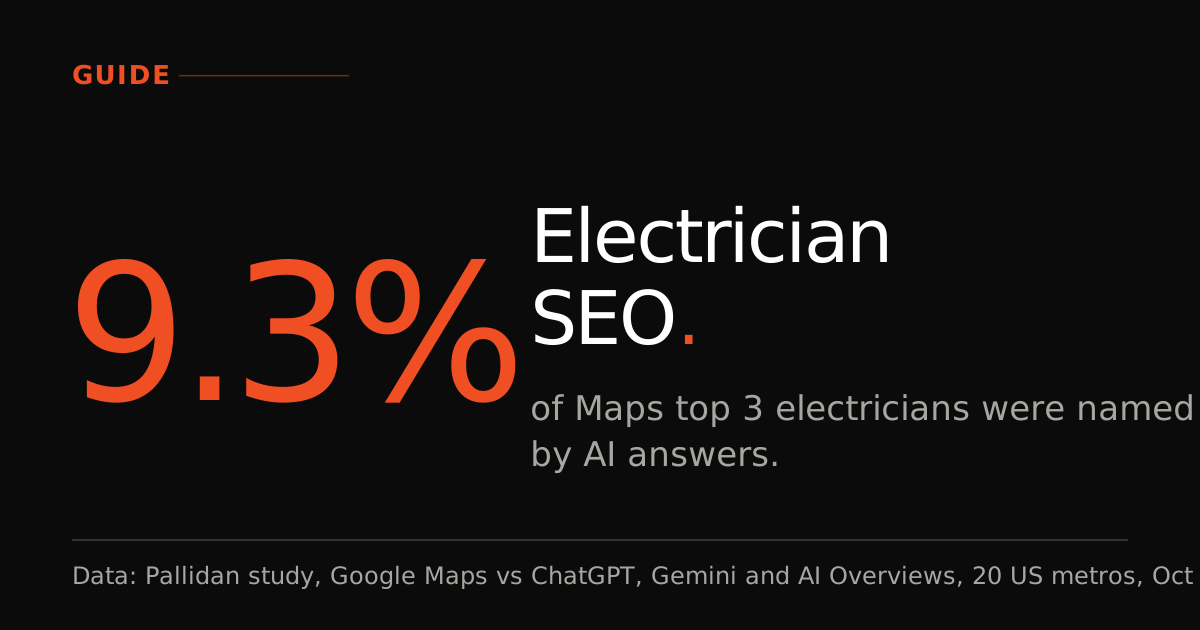
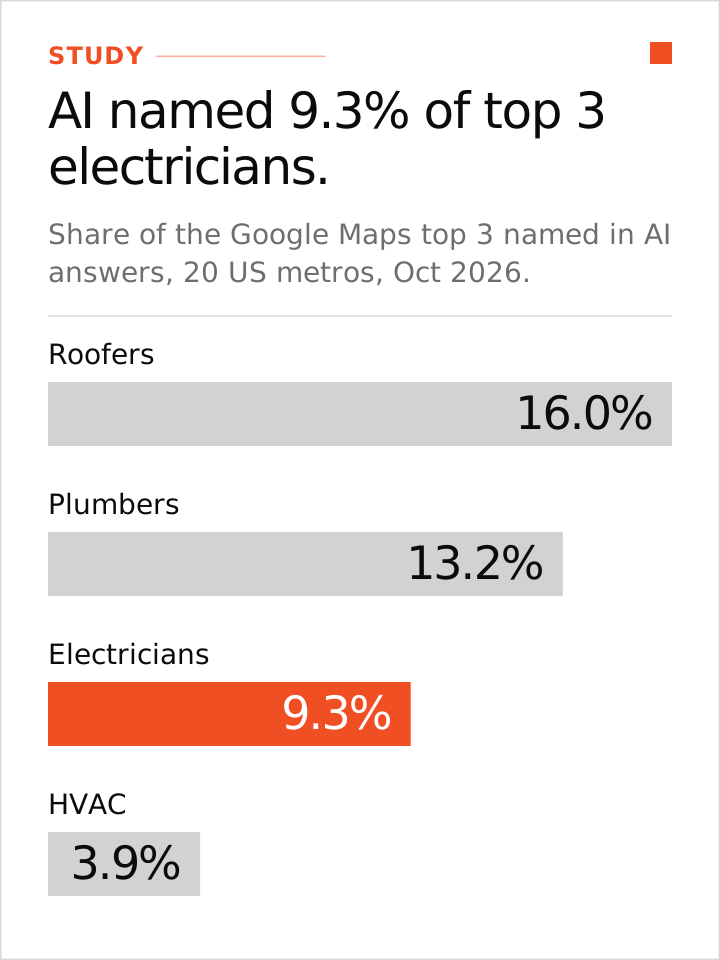
In our study of AI answers for field service businesses, we asked ChatGPT, Gemini and Google AI Overviews for the best electricians in the 20 largest US metros, then compared the answers with the Google Maps top 3 for the same city. AI answers named 9.3% of the top 3 electricians (15 of 162 positions). Roofers were named 16.0% of the time and plumbers 13.2%.
31.2% of the electricians in the Maps top 20 had no website link on their listing. In the top 3 it was 23.3%. An electrician with no website gives Google and AI tools very little to read about the services, the area and the people behind the van.
When we kept only established listings (a website, at least 10 reviews and a real business name), AI answers named 19.0% of the top 3 electricians (15 of 79 checks). Only 29 of the 60 top 3 electrician listings passed that test.
Step 1: Fill in every field on your Google Business Profile
Your Google Business Profile is the listing that shows on Google Maps. For most electricians it brings more calls than the website.
- Pick "Electrician" as your primary category. Add secondary categories only for work you really do, like "Electrical installation service".
- Add every service one by one: panel upgrades, EV charger installation, rewiring, lighting, smoke alarms, emergency callouts.
- Set your service area to the cities you drive to. Hide your home address if customers never visit you.
- Use one phone number, the same one as your website.
- Upload real photos of your team, your vans and finished jobs. Add new ones every few weeks.
Step 2: Build one page for each service
Give each service you want calls for its own page. "EV charger installation in Denver" gets a page. "Electrical panel upgrade" gets another. A single Services page with ten bullet points ranks for none of them.
On each page, say what the job involves, roughly what changes the price, how fast you can come out and how to book. Use your own job photos. Put your license number on the page where your state requires one. Our local keyword research guide shows how to find the words homeowners actually type.
Step 3: Get a steady flow of reviews
Across all four trades in the study, AI answers named 0.7% of listings with under 50 Google reviews (18 of 2,427 checks). Listings with 200 to 999 reviews were named 26.5% of the time, and listings with 1,000 or more 39.6%. Reviews and names go together in this data. The study cannot say whether reviews are the reason.
Ask every customer for a review when the job is done. Send the link by text the same day. Reply to every review, good or bad. Never buy reviews, and never ask only your happy customers (that is called review gating and it breaks Google's rules).
Step 4: Fix your listings on the sites AI tools cite
45.7% of the sources the AI tools cited in our study were directories and ranking sites like Yelp, Angi, Thumbtack and "best of" lists. Only 12.0% were business websites. So your listings matter twice: once for Google and once for the AI answer.
Ask ChatGPT and Google "Who are the best electricians in [your city]?" and write down which sites each answer cites. Claim your listing on each of those sites. Use the same business name, phone number and address everywhere.
Step 5: Link your pages and add schema
Link each service page from your homepage and from the other services that go with it. Panel upgrades link to EV chargers, for example. Add LocalBusiness schema (Electrician is a schema type) with the same name, phone and address as your profile. Our local SEO checklist covers both in more detail.
Step 6: Track calls, then check AI answers each month
Track calls and form enquiries from your website and your Google profile. Those are the numbers that pay you. Once a month, ask the AI tools the questions your customers ask and write down whether you show up. Our guide on getting your business on ChatGPT walks through it.
What electrician SEO costs
If you would rather hand this over, see what local SEO costs. Our SEO and AEO setup is US$4,999 one off, then US$999 to US$2,999 or more a month depending on the work. Want to see what a few extra jobs a month are worth first? Run the numbers in our SEO ROI calculator.
Paid leads are the other route. 99 Calls reported a Google Local Services Ads cost per lead of $35.70 for its electrical clients in Q1 2026. SEO and paid leads work well together: ads fill the calendar now, and SEO lowers what each job costs you over time.