HVAC SEO is the work that gets a heating and cooling company found when someone nearby searches for AC repair, furnace repair or a new system, on Google Search, on Google Maps and in AI answers like ChatGPT. The work is a complete Google Business Profile, one page per service, steady reviews, matching listings and a website behind your profile.
We run this same work for HVAC companies and other trades as part of our SEO and AEO work for field service businesses. You can do every step yourself.
What our data says about HVAC
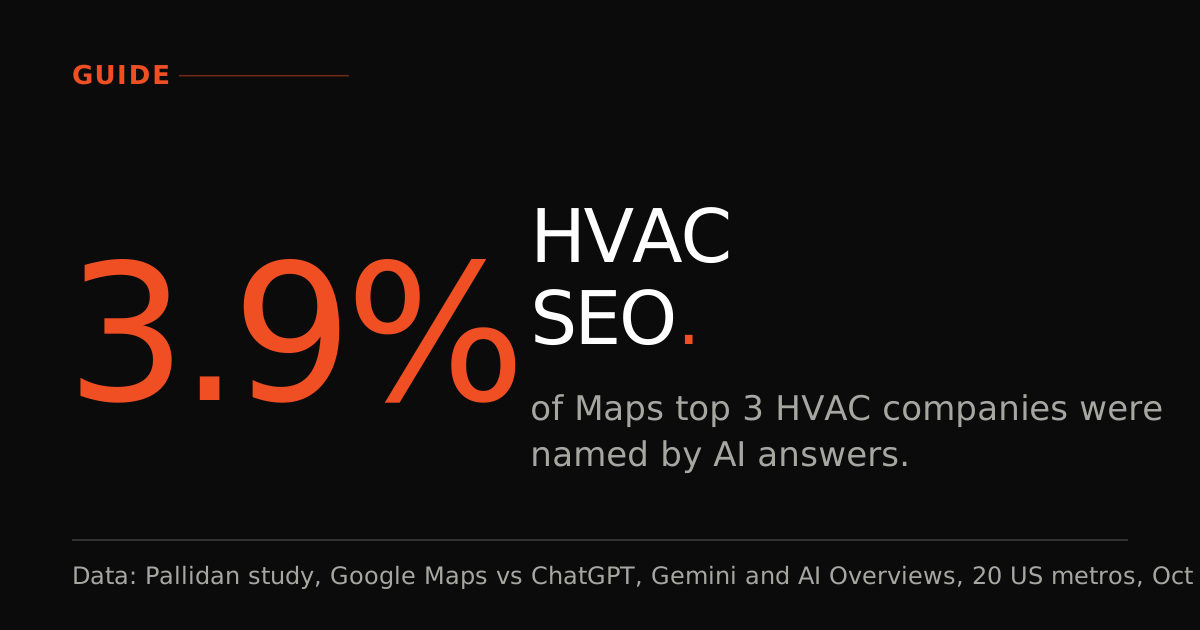
In our study of AI answers for field service businesses, we asked ChatGPT, Gemini and Google AI Overviews for the best HVAC companies in the 20 largest US metros, then compared the answers with the Google Maps top 3 for the same city. AI answers named 3.9% of the top 3 HVAC companies (6 of 153 positions). That was the lowest of the four trades. Roofers were named 16.0% of the time.
Part of the reason shows up in the listings. 32 of the 60 HVAC companies in the Maps top 3 (53.3%) had no website link. Across the top 20 it was 41.8%. Only 15 of the 60 top 3 HVAC listings had a website, at least 10 reviews and a real business name. Those established ones were named 13.5% of the time (5 of 37 checks).
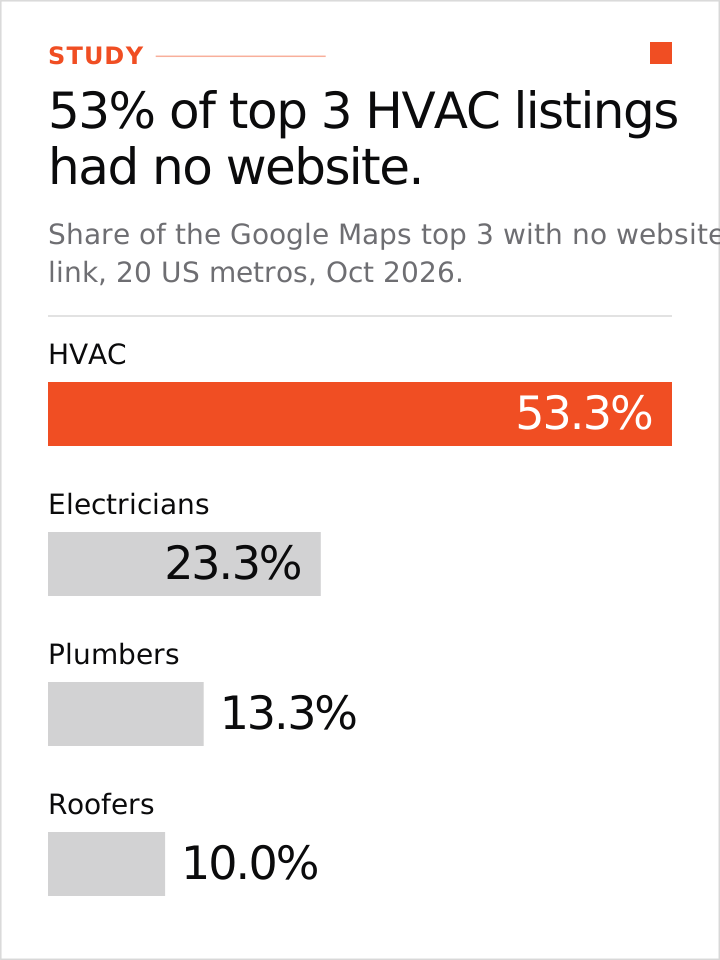
So the gap in HVAC is wide open. Many of the companies ranking on Maps give AI tools almost nothing to read. An HVAC company with a real website, real reviews and matching listings has fewer rivals for the AI answer than a plumber or a roofer does.
Step 1: Fill in every field on your Google Business Profile
- Pick the primary category that matches the calls you want most, such as "HVAC contractor" or "Air conditioning contractor". Add secondary categories only for work you really do.
- Add every service: AC repair, AC installation, furnace repair, heat pump installation, duct cleaning, maintenance plans.
- Set your service area to the cities your techs drive to.
- Set real hours. If you answer emergency calls at night, say so only if someone really picks up.
- Upload real photos of your techs, your trucks and finished installs.
Step 2: Put a website behind your profile, with one page per service
This is the biggest gap in our HVAC data. Build a page for each service you want calls for: "AC repair in Phoenix", "heat pump installation", "furnace replacement". Repairs and installs are different searches, so give them different pages.
On each page, say what the job involves, what changes the price, how fast you can come out and how to book. Add brands you service and any financing you offer. Use your own job photos. Our location pages guide covers pages for the cities you serve.
Step 3: Get a steady flow of reviews
Across all four trades in the study, AI answers named 0.7% of listings with under 50 Google reviews (18 of 2,427 checks). Listings with 200 to 999 reviews were named 26.5% of the time, and listings with 1,000 or more 39.6%. Reviews and names go together in this data. The study cannot say whether reviews are the reason.
HVAC work is seasonal, so reviews tend to come in bursts. Ask after every job all year round, maintenance visits included, so the flow stays steady. Reply to every review. Never buy reviews or ask only your happy customers.
Step 4: Fix your listings on the sites AI tools cite
45.7% of the sources the AI tools cited in our study were directories and ranking sites like Yelp, Angi, Thumbtack and "best of" lists. Ask ChatGPT and Google "Who are the best HVAC companies in [your city]?" and note which sites each answer cites. Claim your listing on each one, with the same name, phone and address as your profile.
Step 5: Plan for the season
Searches for AC repair climb in summer and furnace repair in winter. Update your AC pages and photos before the heat arrives, and your heating pages before the cold. Keep one page per service live all year and refresh it, so it keeps the links and history it has built.
Step 6: Track calls, then check AI answers each month
Track calls and form enquiries from your website and your Google profile. Once a month, ask the AI tools the questions your customers ask and write down whether you show up. Our guide on appearing in Google AI Overviews explains what those answers draw on.
What HVAC SEO costs
If you would rather hand this over, see what local SEO costs. Our SEO and AEO setup is US$4,999 one off, then US$999 to US$2,999 or more a month depending on the work. Want to see what a few extra jobs a month are worth first? Run the numbers in our SEO ROI calculator.
99 Calls reported a Google Local Services Ads cost per lead of $76.45 for its HVAC clients in Q1 2026. That is what each paid lead costs before you win the job. SEO lowers what each job costs you over time.