Case study
BuildHire Compliance: custom dispatch and compliance software for equipment hire
We built BuildHire Compliance with PresciaIQ to run BuildHire's equipment hire jobs from booking to invoice across its Brisbane and Sydney yards. Clients book and pay online, the office assigns drivers from one queue, and a driver cannot mark a machine as loaded until the photos and safety check are filed. It is live in production.
At a glance
205
commits
First commit 3 June 2026, latest 16 July 2026.
3
portals on one database
One for the office, one for drivers, one for clients.
2
yards
Equipment hire in Brisbane and Sydney.
- Client
- BuildHire, equipment hire with yards in Brisbane and Sydney
- Built in collaboration with
- PresciaIQ
- Users
- office staff, delivery drivers, and the builders who hire machines
- Build
- first commit 3 June 2026, latest 16 July 2026, 205 commits
- Services
- Custom Software, AI & Automation
- Stack
- React, Supabase, Stripe, Google Maps Routes API, Xero, Cloudflare
- Status
- live
The problem
The owner wanted every hire to run without a phone call, a spreadsheet or a manual step. A prototype existed, but it was a visual shell: sign in returned errors, nothing saved to a database, payments were static, and every user saw the same screens. We rebuilt it from scratch in our own repository, on BuildHire's own database account.
What we built
Three portals share one database: one for the office, one for drivers, one for clients.
Client sign up and terms
The office invites a client by email. The client signs the hire terms on their phone without creating a password. Every signed agreement keeps the version of the terms that was signed, so a later update never rewrites an old contract.
Booking and bond hold
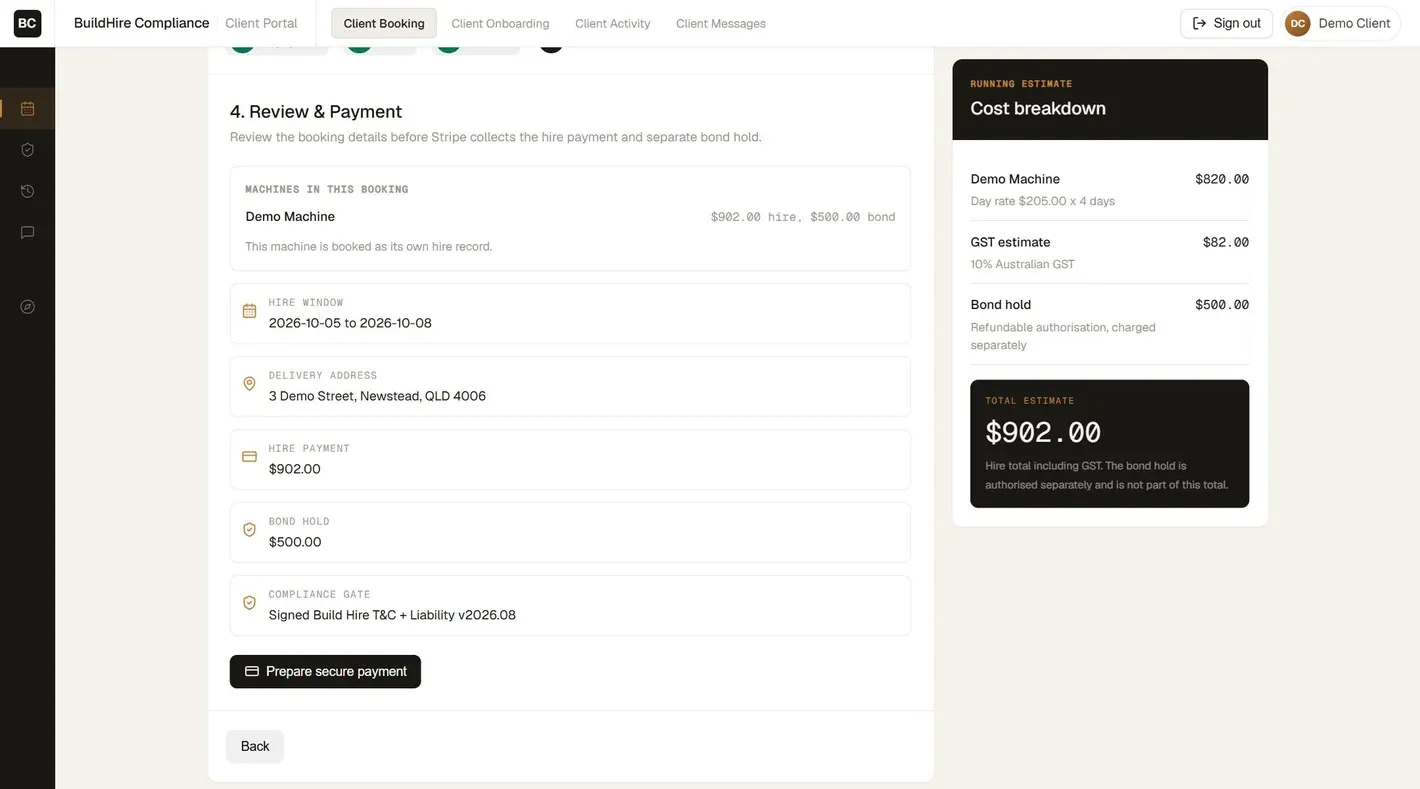
Clients pick the machine, dates and site, see the full cost, then pay. Stripe takes the hire payment and places a separate, refundable bond hold on the same card.
One dispatch queue
Each confirmed booking becomes a job in a single queue. The office picks a driver and assigns the job, and the driver sees it on their phone.
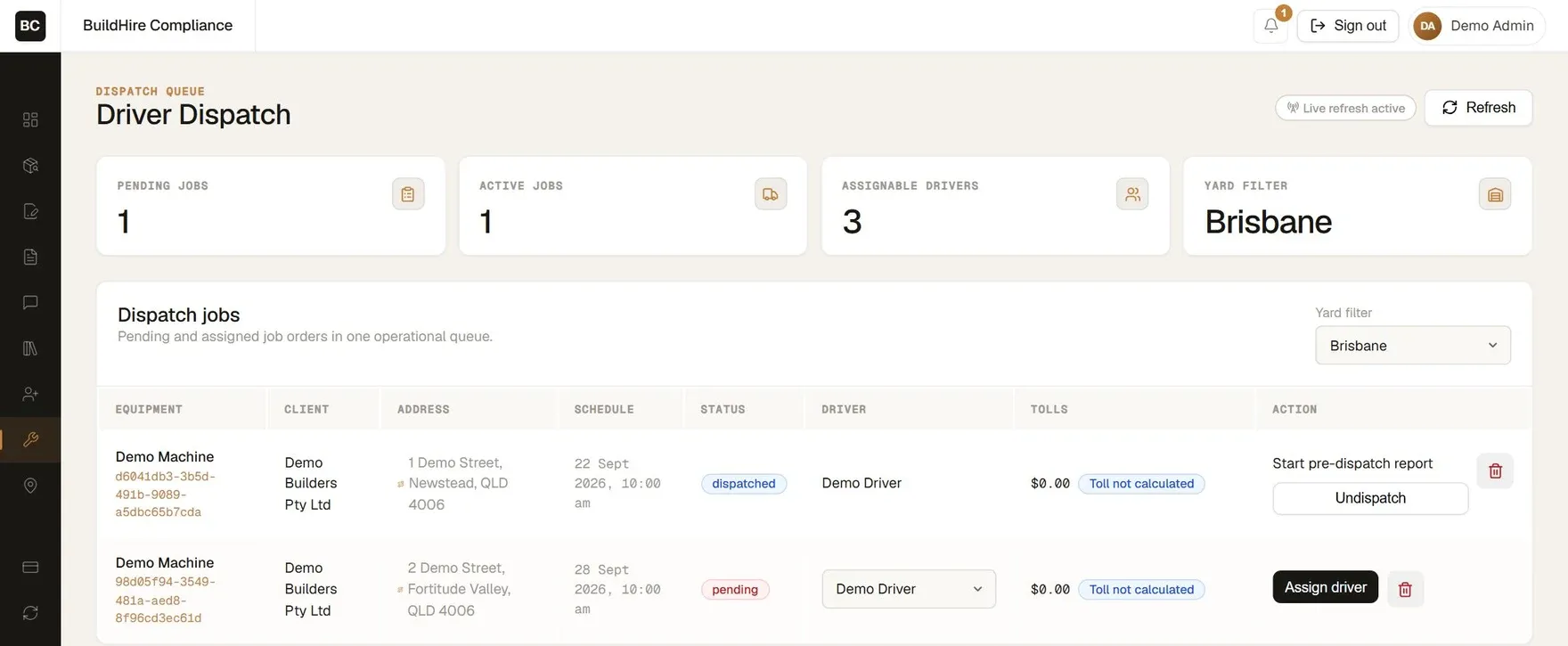
Photo and safety checks before the machine leaves
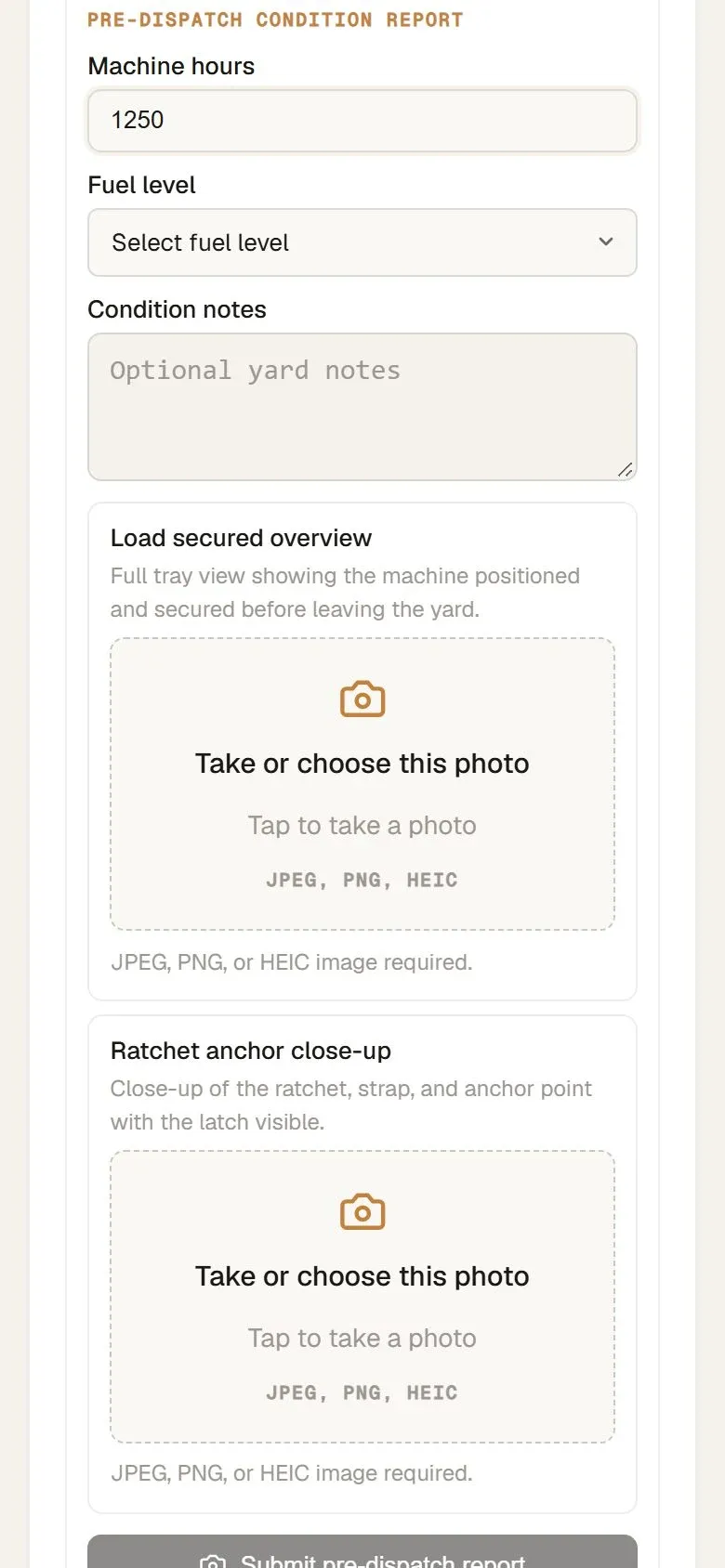
Before loading, the driver records machine hours, fuel level and photos of the machine. Then comes a safety checklist with its own photo: wheel chocks in place and traffic cones out. The "loaded" button stays locked until both records exist, and the server refuses the change too, so the check cannot be skipped from a phone or by calling the system directly.
Return, bond and invoice
When the machine comes back, return photos sit next to the pre-dispatch photos. The office decides whether to capture part of the bond or release it. Tolls are worked out from the delivery route with the Google Maps Routes API, invoices go out through Stripe, and invoices sync to Xero.
A record of who did what
An activity log records every change: who, what and when. Safety logs and condition reports take their time stamp from the server, never from the phone, and they are never hard deleted.
What went wrong and how we handled it
Bond holds on long hires. The plan called for a bond hold that lasts the whole hire. Stripe card holds usually last 7 days, and machine hires can run for weeks. BuildHire's Stripe account was not yet eligible for extended holds, so we shipped a standard hold and moved extended holds to a separate follow-up.
Taking a driver off a job. The office needed to remove a driver from a job before any work started. We added an undispatch action that works only before the driver starts the pre-dispatch report. Jobs further along stay locked, because their records are the job's history.
Removing staff. A driver with job history cannot be deleted without breaking the audit trail, so staff are archived instead and can be invited back later.
Where the automation is
- A paid booking creates the job order.
- Status changes are blocked until the required records exist.
- The driver is notified when a job is assigned.
- Tolls are calculated from the delivery route.
- Invoices are created and synced to Xero, and reminders go out on unpaid invoices.
No AI model makes decisions inside this platform. We built it with AI coding agents under test-driven development.
The numbers
BuildHire runs two yards, Brisbane and Sydney. Office staff, drivers and clients each log in to their own screens. All three use one database.
On the demo booking screen the day rate is $205 before GST. A 4 day hire is $902 with GST.
$205 x 4 days = $820. $820 + $82 GST (10%) = $902. The $500 bond hold is authorised separately and is not part of the $902. No real booking is behind these numbers.
The same setup for a field service business
The same parts fit a plumbing, HVAC or electrical business:
- jobs created from bookings
- one dispatch queue
- a phone checklist with photos before a job is closed
- a deposit or card hold
- invoices that land in your accounting software
Read what a dispatch system needs for a field service business. More examples of our work are on the results page.
Sources
- Stripe, "Place a hold on a payment method", checked 1 Nov 2026: "Usually, an authorization for an online card payment is valid for 7 days."
- BuildHire Compliance booking screen, demo data, viewed 1 Nov 2026: Demo Machine, day rate $205.00 x 4 days $820.00, GST estimate 10% $82.00, bond hold $500.00, total estimate $902.00.
Start with a free audit.